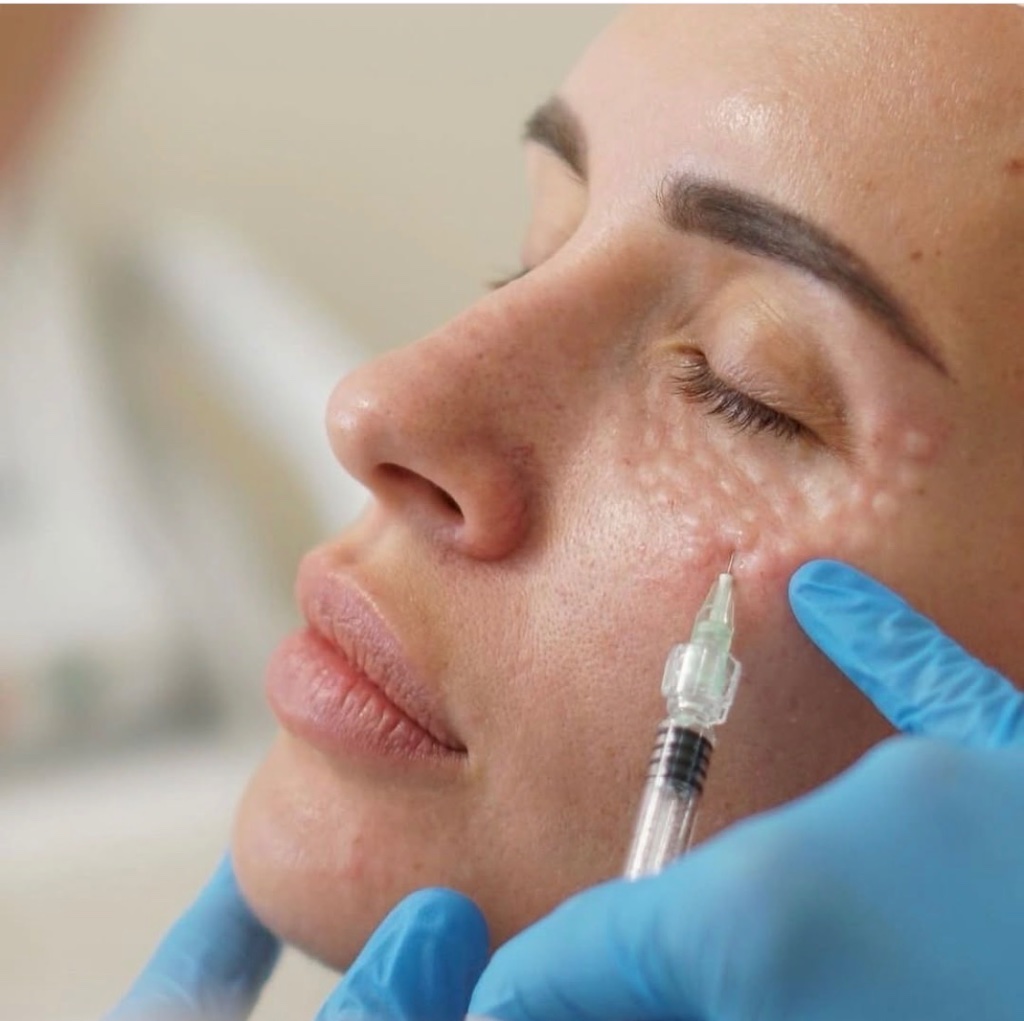
Polynucleotides
Not a filler. Not a booster. Something more biologically interesting.
Overview
Polynucleotides sit at the forefront of regenerative aesthetic medicine. They are not a filler, and they are not a traditional skin booster. They are an injectable derived from highly purified DNA fragments, designed to support the skin's own biology at a cellular level, stimulating fibroblasts, improving microcirculation, and regenerating the dermal tissue itself. At Luminè, every polynucleotide treatment is doctor led, with careful attention to the right indication, the right product, and the right protocol.
Polynucleotides represent one of the most genuinely interesting developments in modern aesthetic medicine, sitting at the intersection of dermatology, regenerative medicine and cellular biology. They are short chains of purified DNA fragments, most commonly derived from the gonadal cells of salmon or trout. These sources are used because the DNA structure of these species shares a remarkable degree of compatibility with human DNA, meaning that once introduced into human skin, polynucleotides interact with our cells naturally and safely, rather than acting as a foreign material.
The product is purified to medical grade standards, with virtually all proteins and peptides removed, leaving only the nucleotide chains themselves. Different formulations vary in molecular weight, allowing them to be tailored to different tissue depths and clinical indications. Lighter molecular weight products for delicate areas such as the under eye, and heavier ones for more structural regenerative work.
What makes polynucleotides distinctive is that they do not fill anything. They do not add volume. They do not change facial shape. What they do is something more biologically interesting. They encourage the skin to function as it did when it was younger. They activate the cells responsible for collagen and elastin production, support microcirculation, reduce oxidative damage, and regenerate the underlying tissue. The visible result, over time, is skin that is firmer, smoother, more hydrated and more luminous, not because anything has been placed in it, but because the skin itself is biologically healthier.
At a Glance
How It Works
The Science Behind the Treatment
01
Fibroblast stimulation through adenosine receptors
The primary mechanism. Once placed in the dermis, polynucleotide fragments interact with adenosine A2A receptors on the surface of fibroblasts, the cells responsible for producing collagen, elastin and hyaluronic acid. Activation of these receptors prompts fibroblasts to proliferate and increase their synthesis of extracellular matrix components, predominantly type I collagen, but also type III, elastin and endogenous hyaluronic acid. Over weeks, the dermis becomes thicker, more elastic and better hydrated.
02
Antioxidant and anti-inflammatory activity
Polynucleotides scavenge reactive oxygen species, the unstable molecules that drive cellular ageing and damage, and modulate the inflammatory environment of the skin. This creates a tissue environment in which fibroblasts and other skin cells can function optimally, and helps reverse some of the chronic oxidative stress that contributes to skin ageing.
03
Support of angiogenesis (microvascular regeneration)
Polynucleotides encourage the formation and improvement of microvessels, supporting better local blood supply. This improves the delivery of oxygen and nutrients to skin cells and the clearance of cellular waste. It is one of the reasons polynucleotides perform particularly well around the eyes, where microvascular changes contribute significantly to dark circles and a tired appearance.
04
The salvage pathway
Polynucleotide fragments are broken down by enzymes in the skin into their constituent nucleotides. These can then be recycled by surrounding cells to support their own DNA synthesis and repair. In effect, polynucleotides provide cells with the raw biological material they need to repair and regenerate themselves more efficiently.
Fine Lines
Polynucleotides do not fill lines. Like other regenerative treatments, they soften fine lines by improving the quality of the skin in which those lines sit. As dermal collagen and elastin content increase, and as hydration and microcirculation improve, the dermis itself becomes thicker and more resilient. The fine static lines associated with dermal thinning, dehydration and oxidative damage gradually soften from beneath, not because something has been placed under them, but because the skin itself is biologically renewed.
The Biological Lift
The lifting effect of polynucleotides is subtle but real, and it is biological rather than volumetric. As the dermis thickens, becomes more elastic, and is better supported by improved microcirculation and matrix density, the skin holds itself differently, tighter, more resilient, with better tone. This is best described as a quality led lift, an improvement in the firmness and resilience of the skin itself, rather than structural restoration of an underlying foundation. For many patients, polynucleotides are particularly powerful when combined with structural treatments, providing renewed skin quality on top of a restored architecture.
Benefits
What to Expect
Genuine regeneration of the skin at a cellular level
Improved skin firmness, elasticity and thickness
Smoother texture and a brighter, more even tone
Softening of fine lines associated with dermal thinning
Particularly powerful around the eyes, few other injectables work as well here
Anti-inflammatory and antioxidant effects on the skin
Suitable for fragile, thin or sensitive skin that may not tolerate other treatments
A regenerative option that complements, and may reduce the need for, traditional aesthetic care
Treatment Areas
What We Can Treat
Under-eye and periorbital
One of polynucleotides' most distinctive applications. Few other injectables are safely usable here, and few work as well for tiredness, fine lines and textural change.
Full face
For skin quality, fine lines and a generalised improvement in tone and hydration.
Neck
Thinning skin and crepiness respond particularly well to dermal regeneration.
Décolletage
An often-overlooked area where biological renewal can be highly effective.
Scalp
Increasingly used as part of hair restoration protocols, often alongside PRP.
Scarring and stretch marks
In selected cases, as recovery support or as part of a broader skin quality plan.
Why Luminè
Regenerative treatments are an area of active medical interest, and polynucleotides are no exception. Product choice, molecular weight, injection technique and indication selection all influence the result. At Luminè, every polynucleotide plan is designed by a doctor with a careful eye for whether polynucleotides are genuinely the right choice for you, and if so, which product and protocol will serve you best. We will also tell you honestly when another treatment is likely to suit you more.
Questions
Frequently Asked
What are polynucleotides made from?
Polynucleotides are highly purified DNA fragments, typically derived from salmon or trout. The DNA is purified to medical grade standards, with proteins and peptides removed. Because fish and human DNA share substantial biological similarity, polynucleotides interact safely and naturally with human cells.
How are polynucleotides different from PRP?
Both treatments are regenerative, but they work differently. PRP uses your own platelets and the growth factors they release to stimulate the skin. Polynucleotides use purified DNA fragments to stimulate fibroblasts and support cellular repair through entirely different pathways. Many patients use both, at different points, as part of a regenerative plan.
How are polynucleotides different from skin boosters or fillers?
Skin boosters typically rely on hyaluronic acid to hydrate and plump the skin. Fillers add volume to specific features. Polynucleotides regenerate the skin's underlying biology, activating the cells that produce collagen and elastin, improving microcirculation, and reducing oxidative stress. The result is changed biology, not added material.
Are polynucleotides safe?
Yes, when administered by a qualified clinician using regulated product. They have an excellent safety profile, and because they are biologically recognised material rather than synthetic filler, the risk profile is different and in several respects more favourable than that of traditional injectables. They are not suitable for those with a known fish allergy.
Will the treatment hurt?
Discomfort is mild. Topical numbing cream is used routinely, and the injections themselves are typically very fine.
How many sessions will I need?
Most patients undergo a course of two to four sessions, spaced two to four weeks apart, with the protocol tailored to the area and the product. Maintenance is usually recommended every six to nine months.
When will I see results?
Subtle improvements within two to three weeks; more meaningful change building over weeks to months as the dermal regeneration unfolds.
Can polynucleotides be combined with other treatments?
Yes. Polynucleotides are often combined with biostimulators such as Sculptra, structural fillers, skin boosters, Profhilo, and PRP. The strongest aesthetic outcomes often come from combining regenerative and structural treatments thoughtfully, rather than relying on any one approach.
A Regenerative Approach to Your Skin
If your concerns are around the eyes, neck, skin quality or a biology led approach to ageing, book a consultation at Luminè. We will assess your skin honestly, discuss whether polynucleotides are the right starting point, and design a plan built entirely around your face.